
If your prints are cracking, peeling, or feeling too stiff, the issue is often not your printer—it’s your DTF hot melt powder. Choosing the right powder can be the difference between a premium finish and a failed transfer.
This DTF hot melt powder guide breaks down everything you need to know—types, usage, curing, and common mistakes—so you get consistent, professional-quality prints every time.
What is DTF Hot Melt Powder?
DTF hot melt powder is the adhesive layer that binds your printed design to fabric. After printing on PET film, the powder sticks to wet ink and, once cured, melts into a flexible glue layer.
Why it matters:
- Ensures strong adhesion to fabric
- Impacts stretchability and durability
- Controls the softness (“hand feel”) of the print
Fine vs Coarse Powder: Which One Should You Choose?
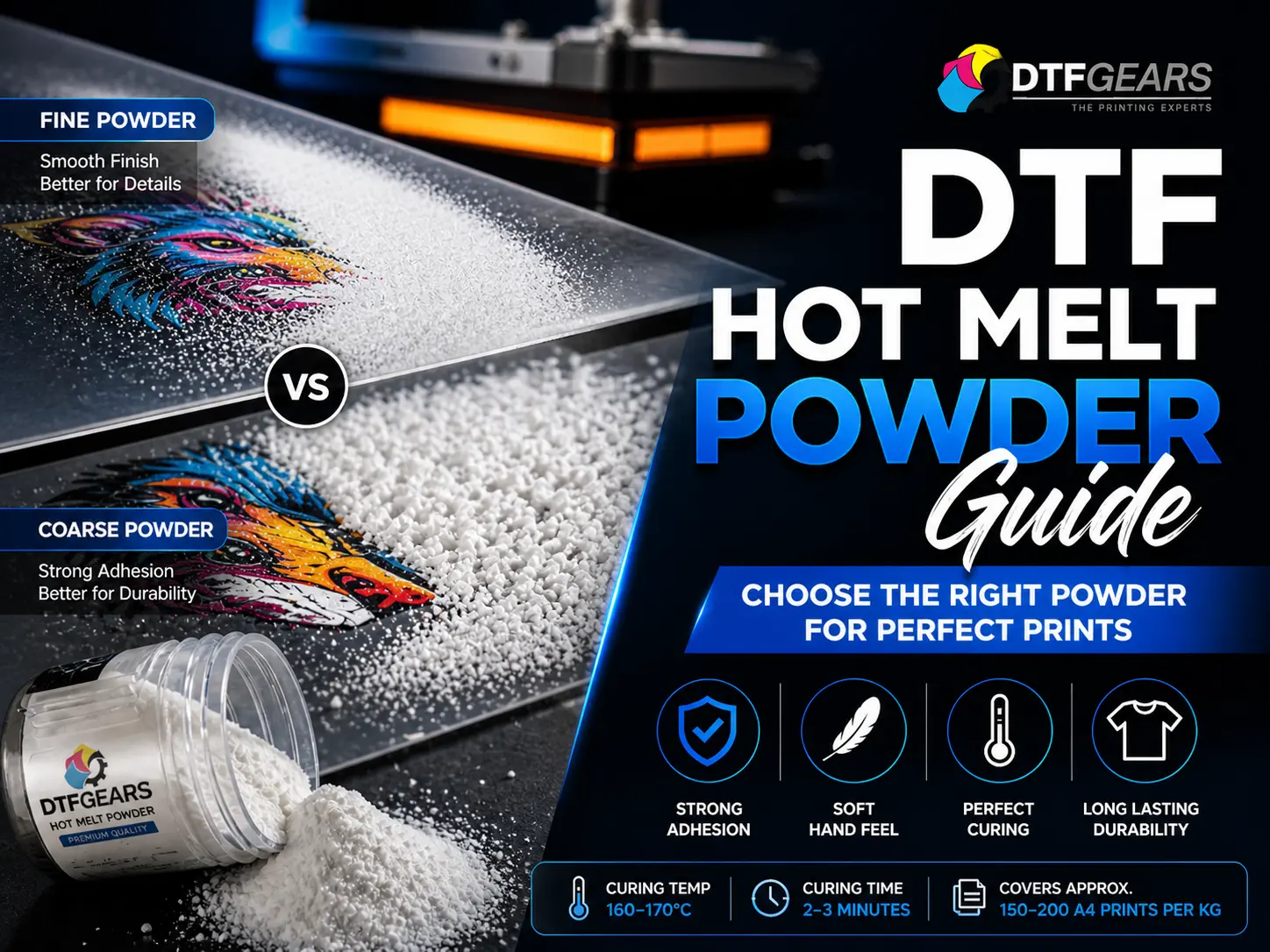
1. Fine Powder (80–120 microns)
Best for detailed and soft prints.
Use when:
- Printing small text or intricate designs
- Working on soft fabrics like cotton
- You want a smooth, retail-quality finish
Pros:
- Softer feel
- Better detail retention
- Cleaner edges
Cons:
- Slightly lower adhesion strength on heavy fabrics
2. Coarse Powder (120–200 microns)
Best for durability and heavy applications.
Use when:
- Printing on hoodies, denim, or polyester blends
- You need stronger bonding
- Designs are bold and less detailed
Pros:
- Strong adhesion
- More durable for rough use
Cons:
- Thicker, slightly rough feel
- Can reduce detail sharpness
Quick Tip
For most businesses, medium/fine powder is the safest all-rounder—it balances detail + durability.
White vs Black DTF Powder: What’s the Difference?
White (Transparent) Powder
- Most commonly used
- Works on all fabric colors
- Leaves no visible residue
Best for: Standard DTF printing jobs
Black Powder
- Designed for dark fabrics
- Helps hide white adhesive edges
Best for:
- Black t-shirts
- Designs where edge visibility is a concern
Pro Insight
If you’re scaling production, stick to white powder unless you specifically need black for aesthetic finishing.
Curing Temperature & Time (Critical for Results)
Getting curing wrong = instant print failure.
Standard curing settings:
- Temperature: 160–170°C (320–338°F)
- Time: 2–3 minutes
What happens during curing:
- Powder melts evenly
- Forms a flexible adhesive layer
- Prepares transfer for heat press
How Much Powder Should You Use?
Less is more—but even coverage is everything.
Ideal application:
- Fully cover wet ink
- Shake off excess completely
- Keep a thin, uniform layer
Average usage:
- 1kg powder = 150–200 A4 prints
Step-by-Step: Applying DTF Powder Correctly
- Print your design on PET film
- Immediately apply powder on wet ink
- Shake off excess powder
- Cure at recommended temperature
- Heat press onto fabric
Common Mistakes to Avoid
❌ Using Too Much Powder
- Results in stiff prints
- Cracks faster
- Feels heavy on fabric
❌ Using Too Little Powder
- Poor adhesion
- Design may peel off
❌ Incorrect Curing
- Under-curing → powder won’t bond
- Over-curing → brittle adhesive
❌ Uneven Powder Application
- Leads to patchy transfers
- Weak bonding areas
How to Choose the Right DTF Powder (Quick Checklist)
- ✔ Need soft feel? → Fine powder
- ✔ Need durability? → Coarse powder
- ✔ Printing general jobs? → White powder
- ✔ Printing on black fabric? → Black powder
- ✔ Doing mixed work? → Medium powder
Product Recommendation: Premium DTF Hot Melt Powder (1kg)
If you want consistent results without trial and error, using a high-quality powder matters.
Why choose DTF Gears Premium Powder:
- Balanced particle size for detail + durability
- Smooth melting for clean transfers
- High adhesion with soft finish
- Reliable coverage (150–200 prints/kg)
👉 Recommended for:
- Beginners and professionals
- Bulk production
- All fabric types
Final Thoughts
Your DTF prints are only as strong as your adhesive layer. By choosing the right powder, applying it correctly, and curing it at the right temperature, you can dramatically improve print quality, durability, and customer satisfaction.
If you’re serious about scaling your DTF business, don’t treat powder as a minor component—it’s the backbone of every transfer.
FAQs
Q: What temperature do I cure DTF powder at?
A: Most DTF hot melt powders cure at 160–170°C (320–338°F) for 2–3 minutes. Always follow the specific manufacturer’s temperature guide for best adhesion.
Q: How much powder do I need per print?
A: On average, 1kg of DTF powder covers approximately 150–200 A4-sized prints. Usage varies with print size and how liberally you apply the powder.
Q: What happens if I use too much powder?
A: Too much powder creates a thick, stiff hand feel and the transfer may crack faster. Too little powder causes incomplete adhesion and peeling. Even, thin coverage is ideal.
Q: Can I use DTF powder with any printer?
A: DTF powder works with any DTF printer setup, regardless of brand. The powder is applied to the wet ink on film before curing — it’s not printer-dependent.